


Do you sometimes feel dizzy, off-balance, or notice the world seeming to move around you? You’re not alone. Millions of people worldwide experience symptoms from vestibular disorders that affect balance, movement, and vision. In this blog—the final one for now written by Stephanie Steggehuis—we explore the five most common vestibular disorders, what they mean, and how understanding your condition can help you regain control and confidence in your daily life.

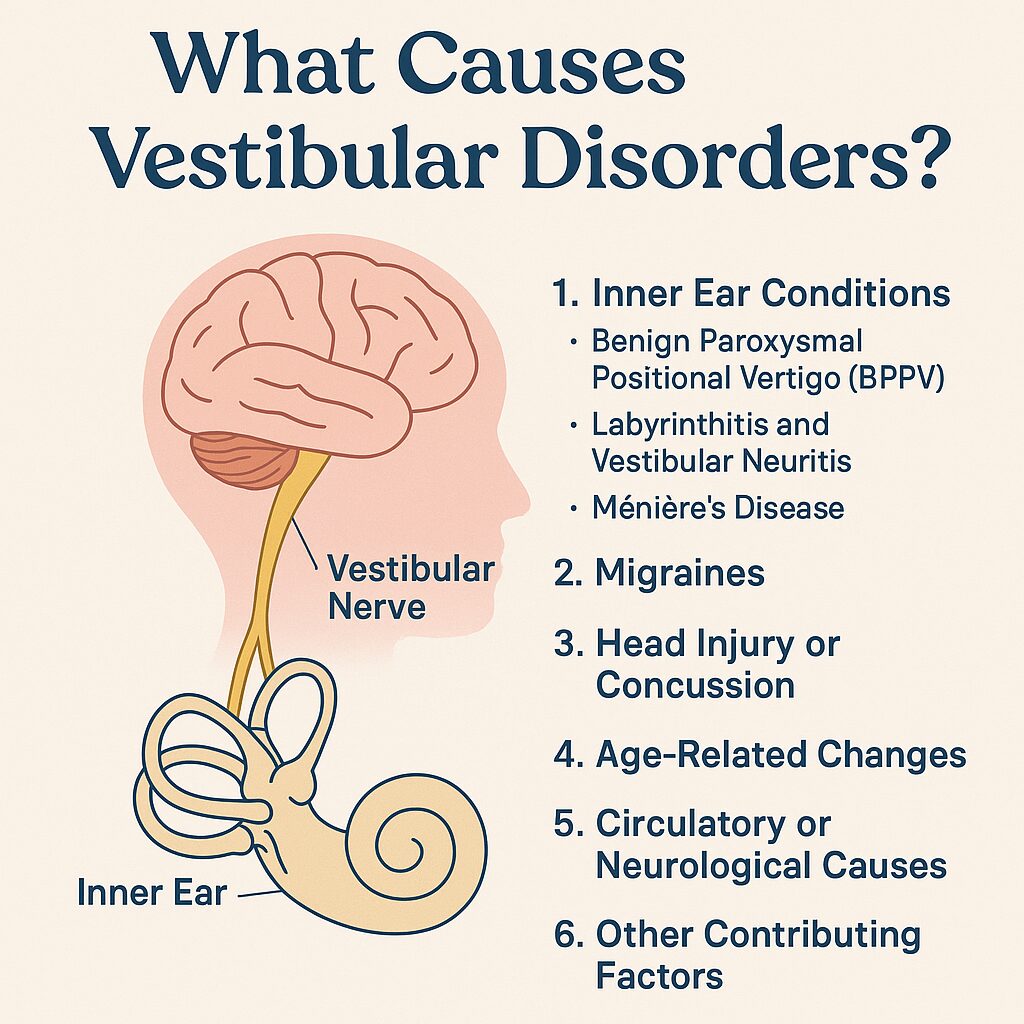
1. Benign Paroxysmal Positional Vertigo (BPPV)
BPPV is one of the most common causes of vertigo. It occurs when tiny crystals in the inner ear move into the wrong place. You’ll usually feel a spinning sensation when you turn your head, roll over in bed, or look up. The good news? BPPV is treatable through specific head movements that guide the crystals back into place.
2. Meniere’s Disease
This condition causes episodes of vertigo, ringing in the ears, and temporary hearing loss. It is linked to fluid pressure changes in the inner ear. Managing salt intake, reducing caffeine, and controlling stress can help reduce the frequency and severity of attacks.
3. Vestibular Neuritis or Labyrinthitis
Caused by inflammation of the balance nerve—often after a viral infection—these conditions lead to sudden, intense dizziness that can last for days. Recovery may take time, and vestibular therapy can help the brain adapt and restore balance.
4. Vestibular Migraine
People with vestibular migraine experience dizziness and imbalance related to migraine activity, even without a headache. Sensitivity to light, motion sickness, and imbalance are common. Treatment focuses on migraine prevention, healthy routines, and managing triggers.
5. Bilateral Vestibular Hypofunction (BVH)
BVH occurs when both inner ears lose function, leading to constant imbalance and unsteady vision during movement. Walking in the dark or on uneven surfaces can be particularly challenging. Rehabilitation focuses on strengthening other senses to help compensate and improve stability.
Understanding Your Diagnosis
Knowing which type of vestibular disorder you have helps you make informed decisions about your care. Each condition has its own pattern, triggers, and treatment options, but all benefit from patience, movement, and support.
Living with a vestibular condition requires courage and adaptation, but it also opens the door to learning new ways to move through life with confidence and stability.
As this is the final blog from Stephanie for now, we want to thank her for sharing her knowledge and personal experience. If you’re looking for ways to feel steadier in your everyday activities, the Balance Belt may help you move more securely and confidently wherever you go.
Written by Stephanie Steggehuis | Marketing Copywriter living with BVH and Oscillopsia